

A pillow bag looks cheap, and a carton costs too much. A buyer picks the bag that looks like a box.
This guide explains the quad seal bag: what it is, why it looks premium, and how it runs. Read it to judge whether the format fits your product.
A quad seal bag has four vertical seals at its corners and a block bottom. The four seals pull the film into a square, box-like shape.
The bag stands on its own, and the flat base keeps it upright. The shape holds from filling to the shelf, with no slump.
A pillow bag is a tube with two end seals, and it lies flat. A quad seal bag stands square, with four flat panels to print on.
The pillow bag shows one panel to the buyer. The quad seal bag shows a full front and a full back.
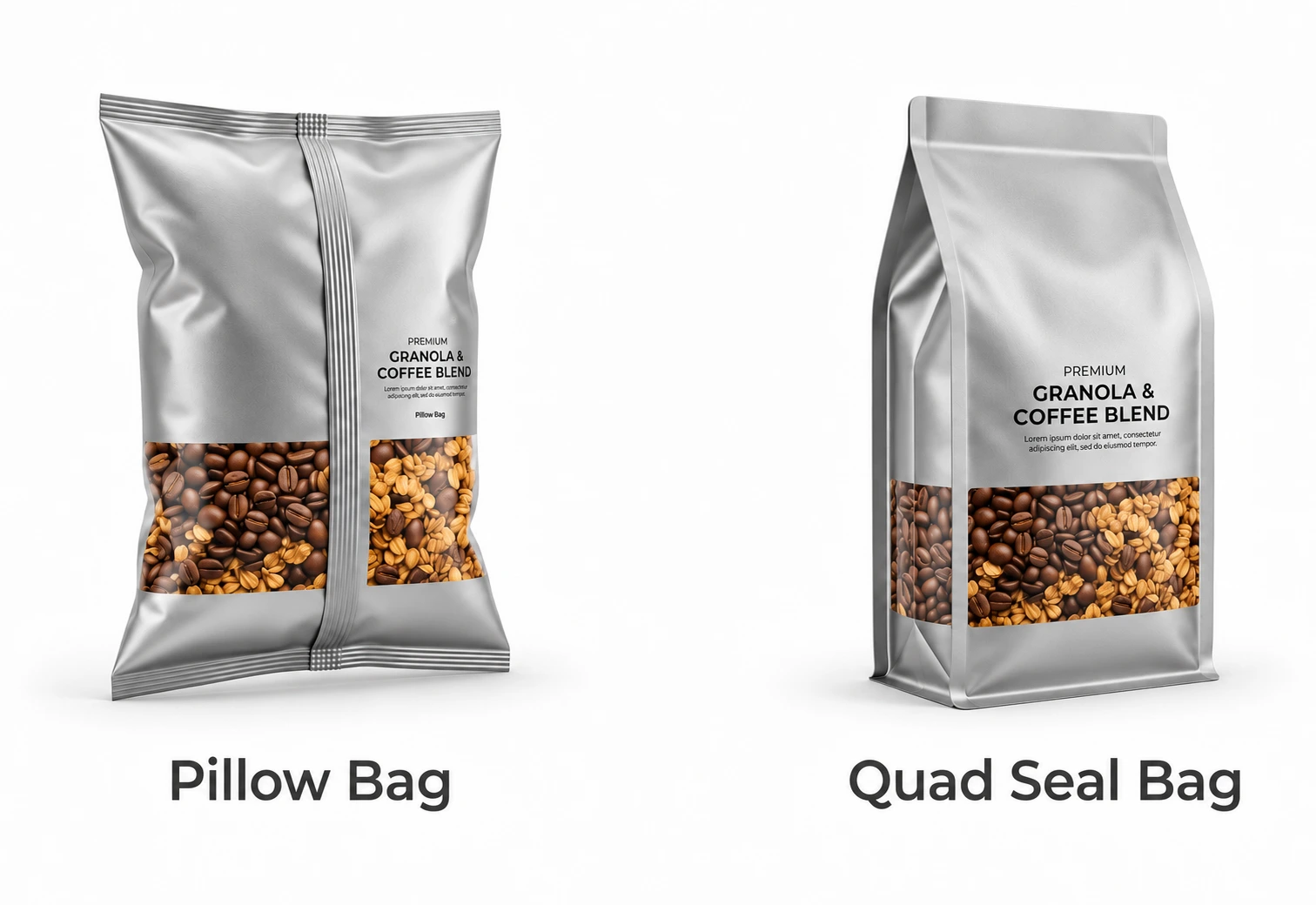
The square shape reads as a carton on the shelf, and the sharp edges catch the eye. A quad seal bag holds its form, so the brand art stays flat and clear.
Front and back panels take a full graphic, with no fold to break the art. The bag looks premium before the buyer reads a word.
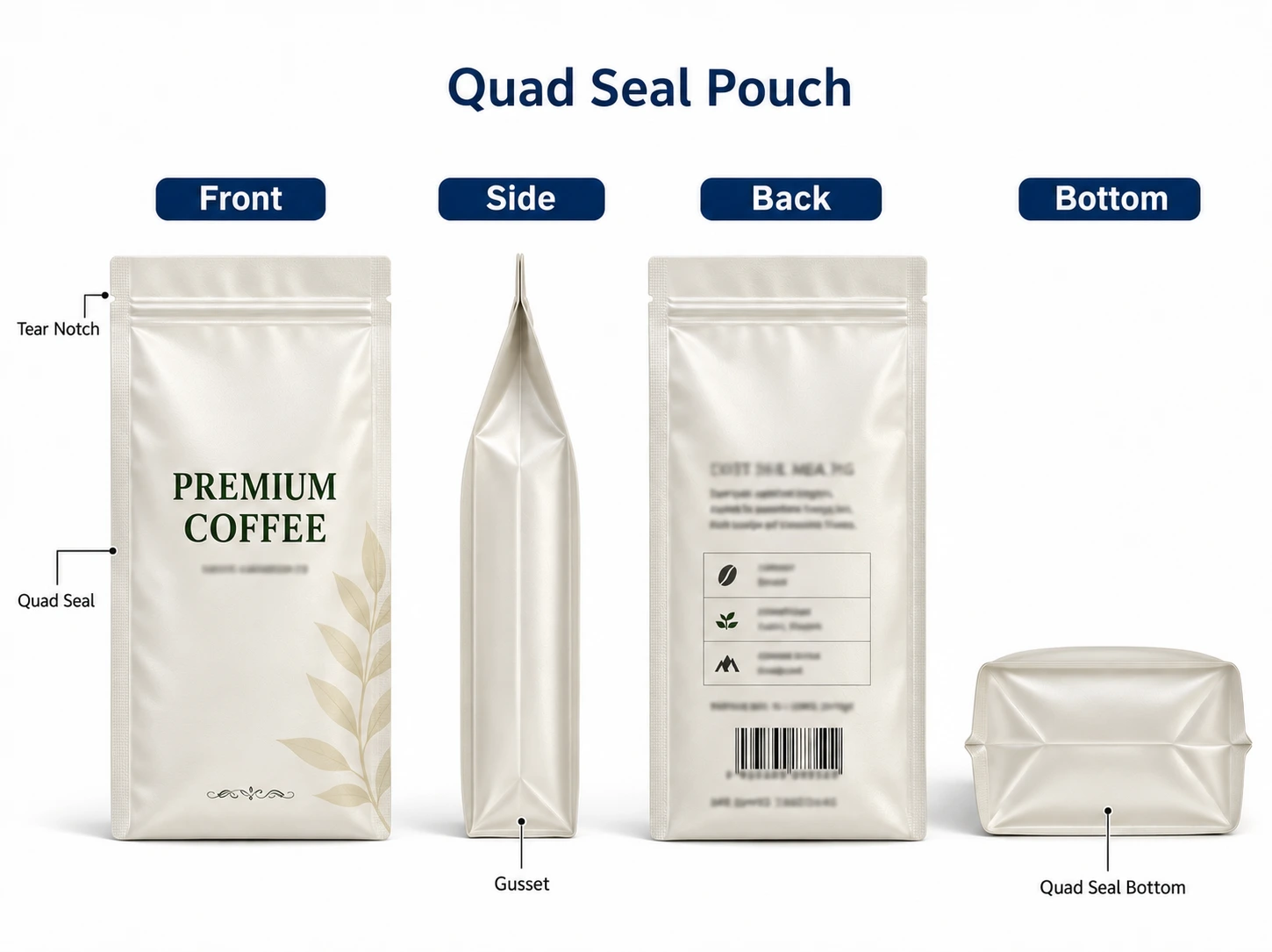
The block bottom gives the bag a flat base, and the bag stands firm on the shelf. It resists tipping when a shopper pulls the bag next to it.
A stable base also helps at the packing table. The bag stays upright while the filler runs, so the line stops less.
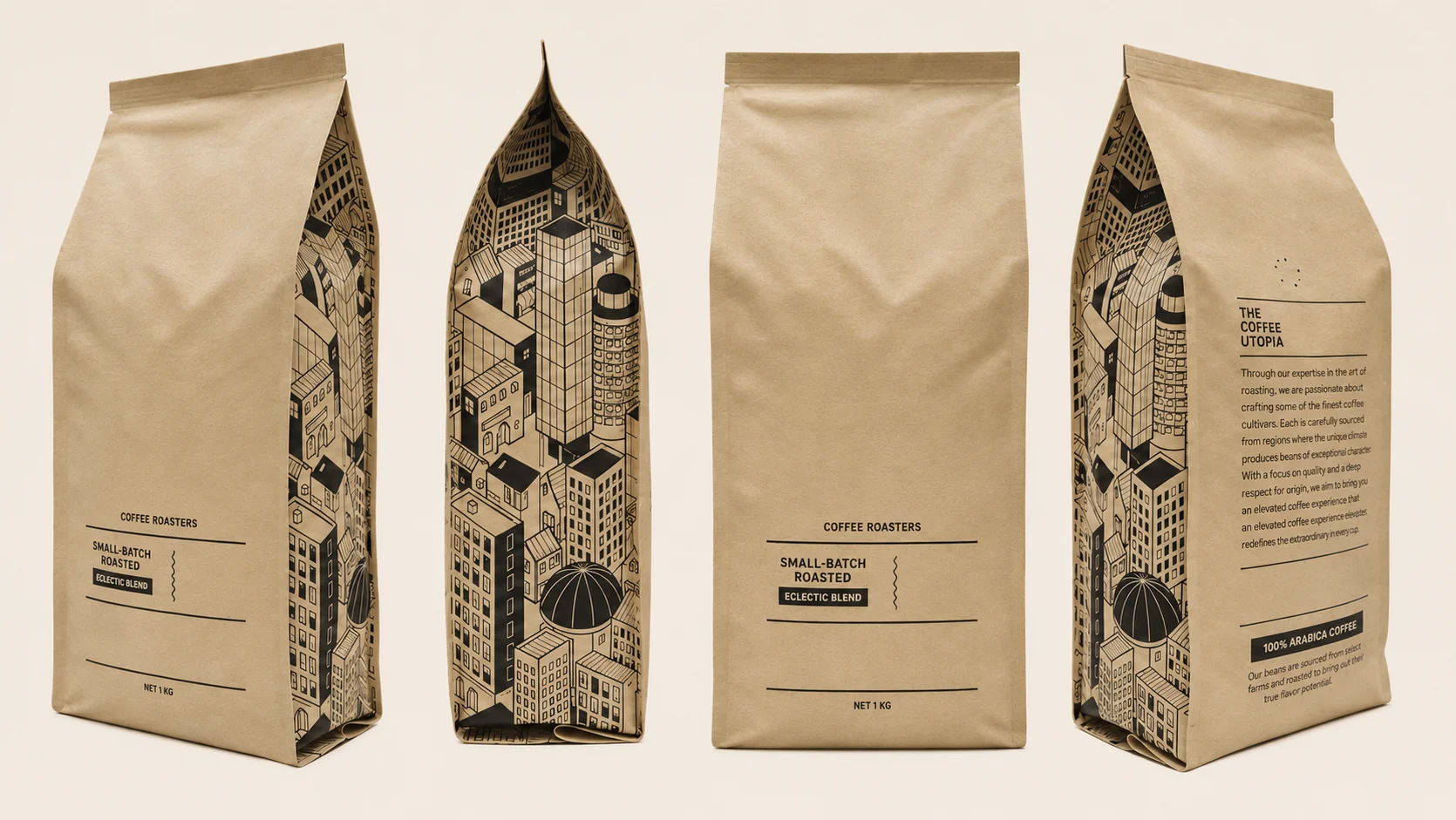
A quad seal bag takes a one-way degassing valve, a tin tie, or tape for easy opening. Coffee brands use the valve to let gas out without letting air in.
The top and bottom gussets tack flat with an outer sealant layer. The ears stay down, and the gable top keeps its square form.
This format uses more film than a pillow bag. The packaging to product ratio runs higher, so the film bill grows.
The extra film buys the square shape and the flat panels. Weigh that gain against the film cost on every order.
This format runs slower than a pillow bag on the same line. The corner seals and the gusset tacking take extra time.
High-speed lines should look at side-gusset pillow bags first. The pillow format keeps the line at full speed.
The outer sealant layer tacks the gussets flat, but it hurts recyclability. A single-material bag recycles easier than a layered one.
Check the recycling rule in the target market before you order. A market with a strict rule may need a different film.
Use a film with an outer sealant layer, so the gussets stick flat at the seal. The layer bonds the folded ears to the bag body.
Pick the film by product weight and shelf life, not by price alone. A heavier fill needs a thicker laminate to hold the square shape.
The forming tube shapes the film, and the corner seals set the square form. The top folds into a gable, and the block bottom sets flat.
Check the first ten bags of a run for square corners. A corner that rounds off means the film or the jaw setting is wrong.
A degassing valve fits during bag making, before the bag fills. The valve sits on the front panel, above the product line.
Test the valve on filled bags, not on empty ones. A valve that leaks lets air in, and the coffee stales fast.
Coffee leads the format, and the valve keeps fresh beans safe. Snacks, baked goods, short-cut pasta, and infant formula also suit the bag.
Ask four questions before you switch: the material ratio, the recycling rule, the speed target, and the film price. The bag fits when the answers favor premium over lowest cost.
A quad seal bag gives a carton look at film cost, with a stable base and full graphic panels. It suits premium coffee, snacks, and dry foods. Talk to LINK Machinery, a CE and RoHS certified China factory, for a VFFS machine that runs your bag.
1. What sizes do quad seal bags come in?
A typical range runs from 150 g to 1 kg, with sizes up to 5 kg for bulk packs. For example, a 250 g pack measures about W130 × H200 + SG70 mm. A 500 g pack measures about W135 × H265 + SG70 mm. Ask the bag maker for the size that fits your fill weight.
2. What film is a quad seal bag made from?
Most packs use PET/AL/LLDPE, or kraft paper with AL/LLDPE, at 100–150 microns thick. The aluminium layer blocks oxygen and light, and the PE layer seals. A heavier fill needs the thicker end of the range.
3. Can a quad seal bag have a zipper?
Yes. Bag makers offer a zipper, a tin tie, tape, or a degassing valve as options. A zipper suits snacks that buyers open and close often. A tin tie suits coffee that buyers fold shut after each use.
4. How is a quad seal bag different from a block bottom bag?
It is one type of block bottom bag. The block bottom family covers many square-bottom packs, and the quad seal type adds four vertical corner seals. Those four seals are what make the pack square and boxy.
5. How is a quad seal bag different from a doypack?
A doypack stands on a bottom gusset, with no corner seals. The quad seal type adds four vertical corner seals and a block bottom, so the pack holds a square form. A doypack suits lighter fills, and the square pack suits a premium shelf look.
6. Can you pack liquids in a quad seal bag?
No, not as a rule. Bag makers list dry goods for this format: coffee, snacks, powder, and nuts. Liquids need a pouch built for them, with a stronger seal and a spout or a cap. Pick the pouch by the product, not by the look.

O email : Molly@xmlk-machine.com
Envia-nos um email
Room 810, No. 35-2 Xinjing Road, Haicang, Xiamen, Fujian, China
Nosso endereço
Tel : +86 18150150881
Whatsapp : +8618150150881
ligue para nós


 português
 English
 français
 ไทย
